Hollow Rotary Tables: Through-Bore Indexing, Tilt Moment and Torque
A hollow rotary table is a rotary indexer with a hole through its axis. That sounds like a small difference from a solid rotary stage, but it changes how a machine is built: cables, air lines, shafts or a beam path can pass straight through the centre instead of being routed around a turning table. The hollow rotary table series at positioningstages.com publishes nine cam indexing models, and this guide explains how to read and size them.
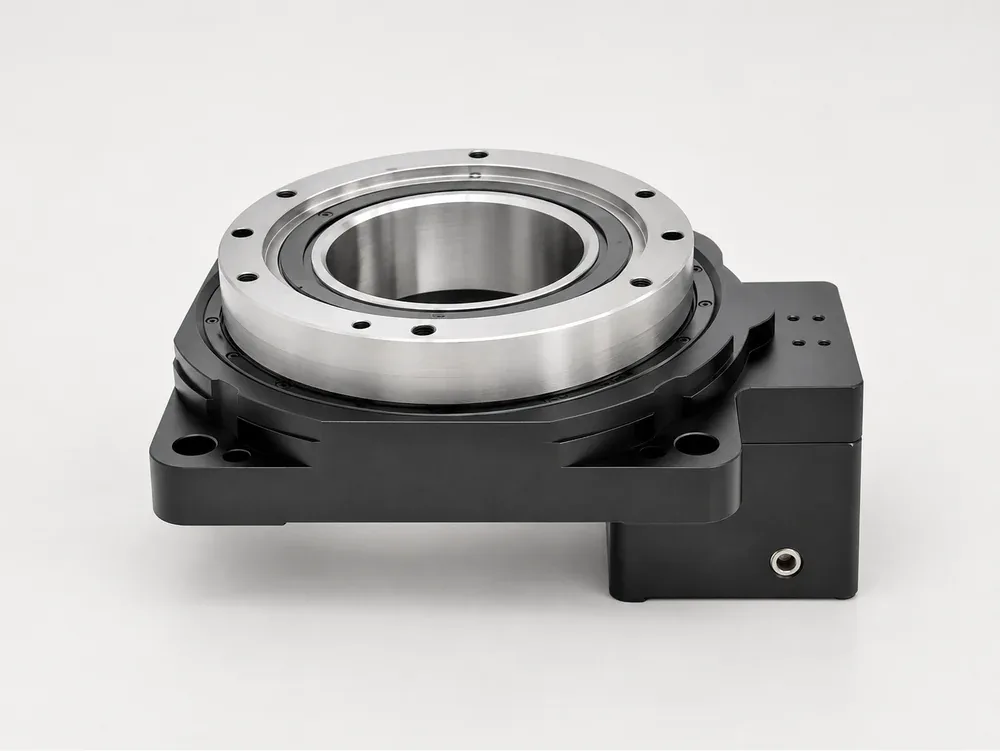
Why choose a through bore?
The through bore is the whole reason to choose this over a solid rotary stage. Anything that passes along the axis of rotation stays still while the table turns, so it does not wind up. Typical uses include cabling to a tool on the table, a vacuum or air line to a gripper, a laser path, or an optical train looking up through the part. That is why these products are also sold as hollow rotary actuators, through-hole rotary tables or hollow rotary platforms.
The series at a glance
All nine models are cam indexers with ±0.005 mm table runout and ±5 arc-sec repeatability. They differ in frame size, rated torque and tilt moment.
| Model | Rated torque | Tilt moment |
|---|---|---|
| CK60F-5 | 10 N·m | 137 N·m |
| CK60F-10 | 6.5 N·m | 137 N·m |
| CK80F-10 | 20 N·m | 369 N·m |
| CK85F-5 | 35 N·m | 369 N·m |
| CK85F-15 | 7.5 N·m | 369 N·m |
| CK130F-10 | 50 N·m | 1090 N·m |
| CK130F-18 | 22 N·m | 1090 N·m |
| CK200F-10 | 90 N·m | 2500 N·m |
| CK200F-18 | 50 N·m | 2500 N·m |
Within one frame size, models with different suffixes share the same tilt moment but list different rated torque, so check both columns rather than the frame alone.
Reading a full specification: CK130F-10
The CK130F-10 product page lists a mass of 2.5 kg, maximum tilt moment 1090 N·m, maximum radial force 8400 N, maximum axial force 8400 N, rated torque 50 N·m and permissible inertia torque 100 N·m. Accuracy figures are indexing accuracy ±0.5 arc-min, repeatability ±5 arc-sec, and table face and radial runout of ±0.005 mm each. Rated output speed is 200 rpm and maximum output speed 350 rpm. Motor and actuation are marked Not stated.
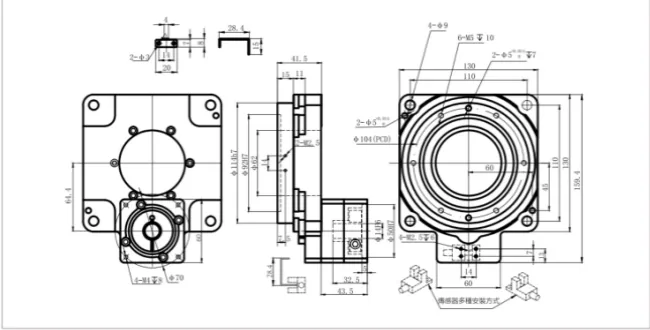
Arc-minutes versus arc-seconds
Indexing accuracy is how close the table gets to a commanded position; repeatability is how closely it returns to a position it has already reached. They differ by about an order of magnitude, and printing both in the same unit would hide that. Sixty arc-seconds make one arc-minute, so ±0.5 arc-min equals ±30 arc-sec, six times the ±5 arc-sec repeatability. If a process indexes to fixed stations and teaches each one, repeatability governs. If stations are computed from a drawing, accuracy governs. The specification basis page covers this distinction for every stage type.
Sizing by tilt moment, torque and inertia
Three ratings decide whether a hollow table survives its load. Tilt moment limits how far off-centre, and how heavy, a load can be before the bearing is overloaded. A light part on a long arm can exceed it while a heavy part close to the axis does not, so calculate weight times offset for anything that does not sit over the centre. Rated torque must cover friction and the torque needed to accelerate the load. Permissible inertia torque limits how hard a large-diameter fixture can be started and stopped. A wide dial plate with tooling at its rim can be modest in mass yet high in inertia.
Speed is the last check. CK130F-10 lists a rated output speed of 200 rpm and a maximum of 350 rpm. In an indexing application, what you usually care about is the time to move one station and settle, which depends on the index angle, the load inertia and the drive tuning as much as on the top speed. Write the index angle, the number of stations, the dwell time and the required cycle time into your request, so that the engineer can check torque and inertia together instead of separately. Mass is worth recording too: at 2.5 kg for CK130F-10, the table itself is part of what the machine frame must carry.
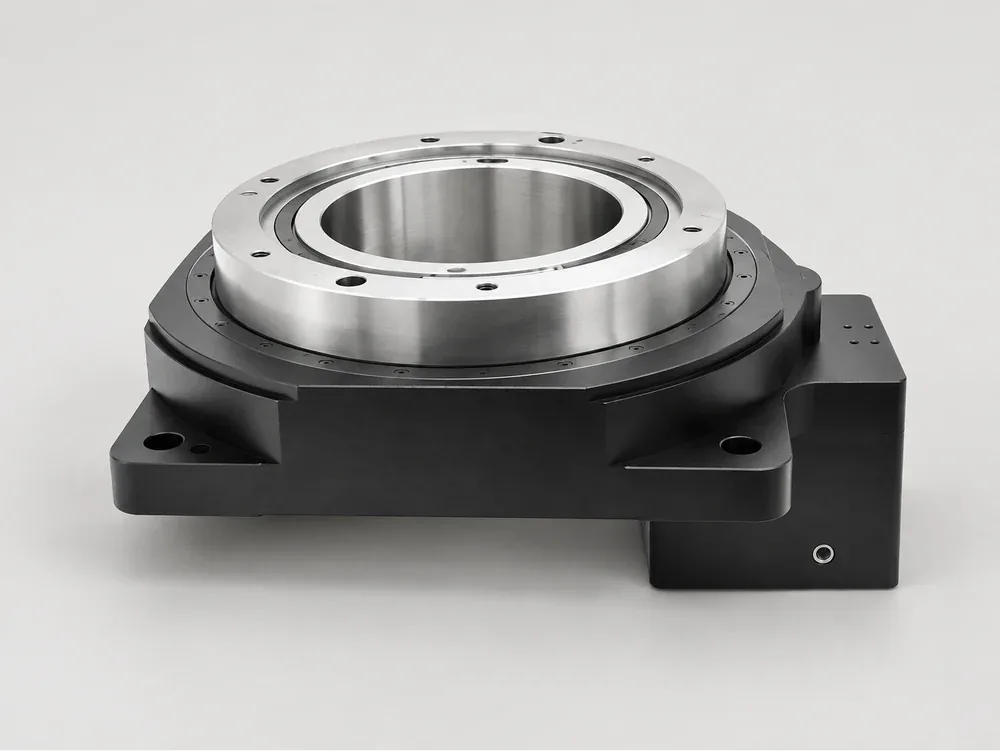
When a different rotary stage fits better
If you need fine angular alignment over a few degrees rather than indexing, the ball-screw models in the rotary stage series reach ±0.002° repeatability. If you need to tilt about a point above the table, use goniometer stages. For a hollow table, confirm the motor, drive, controller and cables in your quotation request, together with what passes through the bore. The full catalogue is at positioningstages.com.
Frequently asked questions
What is the hole in a hollow rotary table for?
Passing cabling, a shaft, a vacuum or air line, a laser path or an optical train through the axis of rotation without it winding up as the table turns.
Why are accuracy and repeatability in different units?
Indexing accuracy is published as ±0.5 arc-min and repeatability as ±5 arc-sec. Sixty arc-seconds make an arc-minute, so the figures differ by about an order of magnitude.
What does the tilt moment rating limit?
How far off-centre, and how heavy, a load can be before the bearing is overloaded. It ranges from 137 to 2500 N·m across the series.
Is the motor included?
Motor and actuation are listed as Not stated in the catalogue. Confirm the motor, drive and controller in the quotation.
Contact
Sizing an indexing table? Send the load, its offset from the axis, the index angle, the cycle time and what passes through the bore. Email sales@deyivision.com or visit the positioningstages.com contact page.